












Trust in Me
Saturday, February 09, 2013
This is an old post. I didn't publish it way back when, because the situation was still very charged, and I didn't want to make it all about that one specific interaction. But, we've moved on now and I think there are some general points here worth sharing and discussing. So here it is.A few interactions in one of the weekly games I'm in has highlighted some issues of trust in roleplaying so I figured I'd say a few words on the subject.
"As the GM, I describe the failure."
"Right. But you can't just say anything, right? It has to suit the character and not violate the player's vision, and it has to make sense with what has come before and..."
"Uh, that's not what the rule says. It says the GM describes the failure. Here's the actual text: 'Every so often, you’re going to lose control of your character for a moment. When you attempt to do something and fail your test, the GM gets to take over and describe something that went wrong. He can tell everyone about something you did that was misguided or even bad. Or, he can describe an unforeseen effect that your actions caused. He gets to stick it to you for a moment.'"
"Well, sure, that's what the book says, but you still have to make sure it's okay with the player and doesn't mess up their idea of the character..."
And that's when I realized that the player -- on some deep level -- just didn't trust me, as GM, to "do it right" when it came time to take control of their character on a failure. And not just their own character, but any PC.
And it turns out that the trust issue encompasses not just PC agency, but "the story" as well. Here's another exchange between two players:
"Yeah, I could have my character really go down this dark path..."
"But that's not great for the story, though. It's one dimensional to have a character that just spirals down like that."
"Yeah, well, that's where I see this going."
"I know, but it makes a weaker story that way. One-dimensional characters are boring..."
Again, the trust just isn't there. The PC going down this dark path is "doing the story wrong" (as if that was possible) or at the very least, making the story somehow worse. The objecting player has certain standards that must be honored, or his enjoyment of the game will suffer -- which is perfectly normal, of course -- but he doesn't trust the rest of us not to mess it all up for him.
As a result, we often end up debating the merits of player decisions, story points, NPC behaviors, and rules applications whenever any of them begin to diverge from the standards and preferences of this player. He's worried that we're going to weaken the story, make a critical error, do something that doesn't "make sense," or otherwise disrupt the fictional space inside his head. On some level, He just doesn't trust us to get it right.
When the trust is there, there's no need for lots of front-loaded debate and discussion before establishing the action. A fellow player does something that seems odd or the story takes a bizarre turn or a rule is applied in an unexpected way and it's okay. If you trust everyone sitting around the table, you can take a wait-and-see approach. Maybe it seems a little odd or unexpected now, but you trust that it will all work out. You give the benefit of the doubt.
When the trust is there, everyone is free to play hard, be bold, and put their stamp on the game. Their vision might be different from your vision, and that's okay. Playing with trust means coming to the table excited to hear what the other players are going to say -- whatever it may be. That's why we play these games with particular people, right? That's why we stay in groups with creative, interesting, engaging players and leave the groups that don't click for us.
Sure, sometimes you need to be firm and hold your ground. Sometimes you fight for your specific vision of the game. But when it comes from a place of trust, you're fighting with your respected peers. You're advocating for your ideas, not shooting theirs down. When it's not based in trust, you're trying to shepherd the other players -- steer them, guide them, show them the right way. You're fighting to protect yourself from their "bad ideas."
I'll say that again: You're fighting to protect yourself from the so-called bad ideas of your fellow players. If you're in this place, it's time to reassess. Do you really want to be playing with these people? Maybe play with people you trust more. Do you really want to trust this group, but find it hard to? Maybe press on and try to release the iron grip of control.
Also, consider this question: What did these people do to lose your trust? Often, the answer is "nothing." The lack of trust may be coming from past experiences or other issues. Try to give your fellow players the benefit of the doubt. Relax, and fly casual. The thing that seems so wrong or strange to you right now may turn out to be really cool if you allow your fellow players to take risks and be spontaneous.
Labels: gaming, rpg theory
Ghost Lines v 1.5
Thursday, January 31, 2013
Just updated the Ghost Lines PDF to version 1.5. It's 4 pages now. The fourth page is:- Rumors table
- Patrons table
- City Events table
- Ghost qualities
- NPC features
Also made a few minor text tweaks here and there.
EDIT: Also updated the InDesign file package.
Labels: gaming, ghostlines, hack, rpg
Ghost Lines: 3rd Age Rail Map
Friday, January 25, 2013
Here's the map we're using in our game.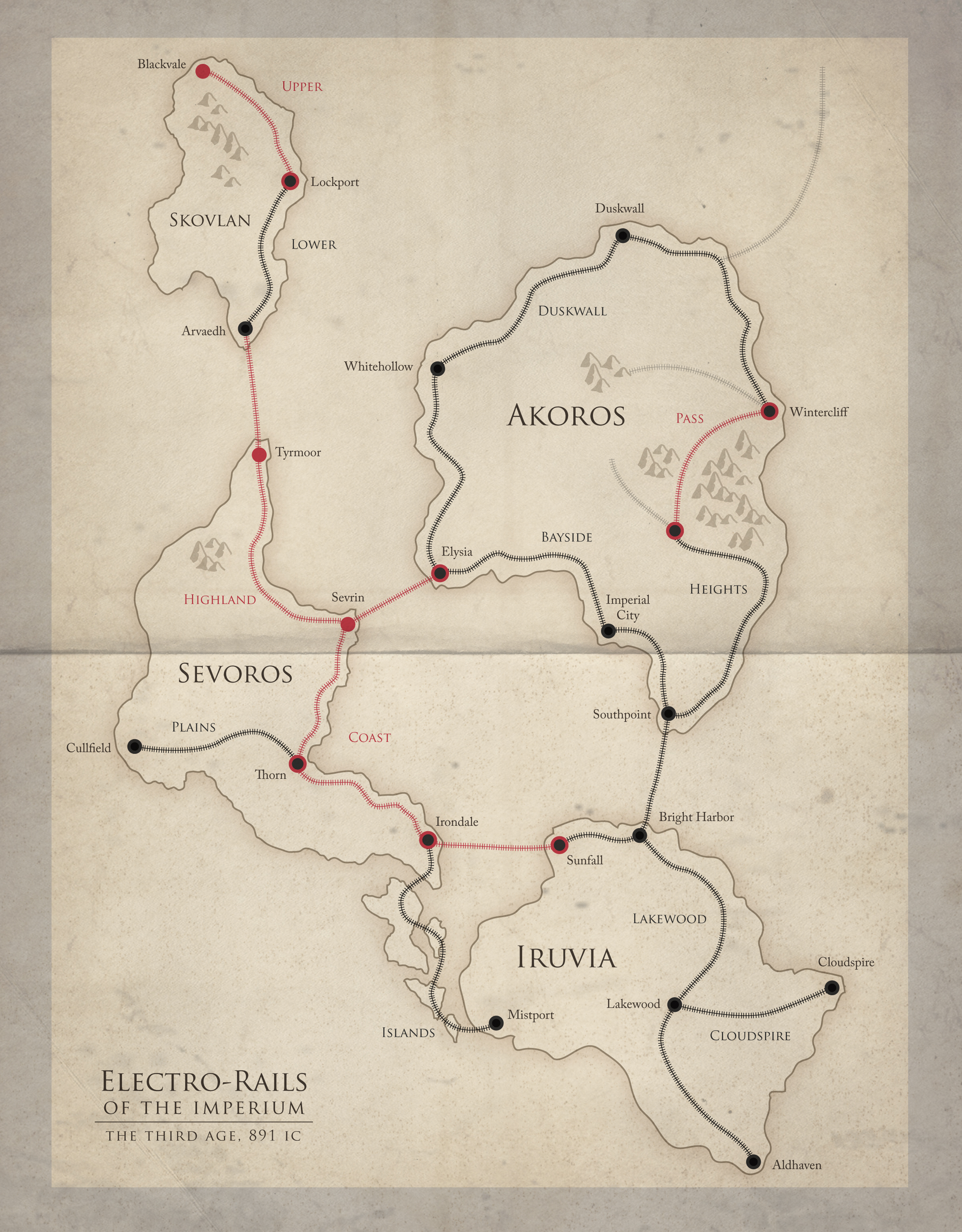
You might want to make your own, but if not, click on the preview for a printable hi-res version.
Labels: gaming, ghostlines, hack, rpg
Ghost Lines 1.1 / INDD files
Here's an updated version of Ghost Lines, now with credits, instructions on leveling up, rolling the dice, lightning-oil usage, and some minor tweaks. Thanks for the feedback, everybody! Also, if you want to hack it, do a translation, or whatever, it now has a Creative Commons license (CC BY-NC-SA). And here's the InDesign file package.Labels: gaming, ghostlines, hack, rpg
Ghost Lines: Mini-game AW hack thing
Thursday, January 24, 2013
Hey there. This is what I'm designing/running right now. It's a 3-page micro-hack based on Apocalypse World, Dishonored, and Ghostbusters.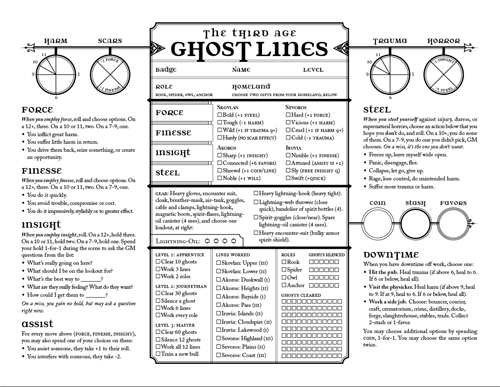
Our World of Dungeons world got destroyed in a supernatural cataclysm, so we decided to move the timeline forward 1,000 years and play a new game. This is the result.
It might be playable by people who aren't us, who knows? I figure some of you will probably want to give it a whirl. I'm happy to answer questions.
Labels: gaming, ghostlines, hack, rpg
What to Say When Someone Asks You What Gaming is All About
Tuesday, February 09, 2010
I can show you, if you want. It will take about 5 minutes. Okay? Okay, so, imagine you're a homicide cop. A Detective like on Law & Order.You're interviewing a suspect. He's a mechanic. You're at a garage where they fix old cars. It's after hours now so it's quiet but it still smells like grease and gasoline. You're there with your partner.
This guy—this mechanic, his name is Arnie Johnson—he matches the description of the suspect given by an eye-witness. Six foot four, heavy set, dark cropped hair and beard, tattoos. He's the brother-in-law of the victim.
Arnie says, "Is this about Sarah? I don't know anything about that." He's sweating and his eyes are all over the place. What do you say to him?
That should do it. Just play Arnie and react to their questions. If they wonder about the crime (what happened to the victim?) tell them the facts (she was murdered in her home. stabbed with a knife from her kitchen. no forced entry.) and get back to the interview.
Here's the thing: Arnie's wife—the victim's sister—did the actual murder. A crime of passion when she found out that Arnie and Sarah slept together. Arnie was there during the murder. He was seen leaving the house (but his wife wasn't).
Arnie feels guilty and desperate. He might crack or he might clam up or he might lie and say he did it to cover for his wife. Just play him in the moment and react to the cop's questions.
If he lies, tell them it looks like he's lying. Don't make it a big mystery to solve. This is about what the cop will do and say to get at the truth.
When it happens that the cop presses Arnie and he doesn't want to answer ("That's a lie and you know it! Who was there with you?") then say this:
We're at an impasse! You want Arnie to talk and he wants to lie and get away with it and be left alone. Who gets what they want? This is where the game part comes in. Our rule is: You can force Arnie to answer you three times. (Hold up 3 fingers). Just say how you force him to answer, and he'll have to tell you the truth. The catch is, each time you force him you have to do more to get him to answer.
Be pretty strict about your promise of 5 minutes. Once you hit the time limit, say, "So it's been five minutes... I think that basically shows the idea." If they're all desperate to find out the truth from Arnie still, then good! It's gone well. Go ahead and keep playing if it seems appropriate, or maybe take that opportunity to invite them to a game night.
Labels: gaming, rpg theory
How Do We Know How To Play?
Monday, September 15, 2008
Over on One Thousand One, Brand asked me a good question:"How do we know what 'playing Dogs in the Vineyard' is? As opposed to how we know what 'playing Game X' is?"
I'm gonna answer him here since it got rather long.
This is a thorny issue, historically. In my experience, through the 80s and 90s, we simply knew "how to roleplay." This was collected wisdom from oral tradition, game books, Usenet, and the early Internet. There were good roleplaying practices and bad ones, and overall the activity was seen as a monolithic thing. When it came to a specific game, "knowing how to play Game X," meant understanding the resolution mechanics, character generation, and how to portray your character at the table (be moody! be heroic! shut up and kill stuff! etc.). Pretty much all stuff at the technique level, in other words. But "good roleplaying" was a thing unto itself -- a science and art that could be studied and improved independant of the game played.
Add to this the notion of "my game" that a lot of GMs had (and have still). The idea was, we're not just playing Game X, we're playing in "Tom's Game X campaign." In this case, Tom is the authority on what "playing Game X" means, and you either read his social cues and participate in the expected ways, or you find yourself ostracisized from the group (or asked to leave if Tom has the nerve). It doesn't matter what you think "playing Game X" means (or what the book says, for that matter) if it doesn't align with Tom's authority. To cloud the issue even more, a lot of game books endorsed this approach with things like Rule Zero.
Establishing and defending what "playing Game X" meant to Tom (and his supporters) was often a primary activity for some game groups. Endless discussions on what would "make sense" or "really happen" -- creative differences disguised as logic problems -- could easily take up hours of game time. Stepping out of line with Tom's vision could result in ridicule or more bitter debates and appeals to logic.
(Full disclosure: I was Tom. More than once.)
So... how did we know what "playing Game X" was? Honestly, I don't think I did. Not every time. This applies to lots of games and game groups that I experienced all through the 80s and 90s (and still see in action today). Generally, many groups got by with status games. Whoever was seen as highest status in the group would enforce what "playing Game X" really meant, and essentially coerce the lower-status group members into appropriate behaviors (and marginalize those who didn't behave).
In the absence of these status games and murky Rule Zero advice, I found the other way to know how to play a game:
1. Shared understanding (explicit and implicit) and communication between the players.
2. A rules text that tells us what is expected of us as players and GM (as people at the table!), creating a shared roadmap for play. A document we can point to and say, "Yes, I want to do what it says in there." Most importantly this trumps appeals to "good roleplaying" or "how I always do it" or "what should happen."
(My first experience with this combo was playing Star Wars D6 with a good group of people.)
This is how I know what "playing Dogs in the Vineyard" is. By playing in a group with a shared understanding and communication about what matters to us (a social contract, you might even say), using a rules text that establishes clear expectations for play. Play becomes a process of reinforcing and celebrating the expectations and procedures of the game as communicated by the text (most importantly: not just "the mechanics") and the shared understanding of the group.
Whew!
So there it is. I don't think any of that is controversial at all, but I'd love to hear your comments.
Labels: gaming, rpg theory
A D&D4 Moment
Monday, September 08, 2008
We're fighting a Red Dragon. Yeah, it's like that. The thing swoops down and hits us all with fear and breathes fire on us and we're in bad trouble. Not to mention all the cultists in the background doing the ritual to unmake the world. Tony's wizard nails the dragon with his magical remote-controlled hand of ice ("I have it by the balls.") and my Warlock drops both his big daily Curses on the thing (action point!) but it doesn't seem to care about our pathetic attempts and turns its full rage on the Fighter and Paladin who are up in its grill.There's a lot of claw/claw biting going on, and Paul's Fighter is headed for the mead-hall in the sky. Phil's Paladin steps in and does that awesome power where he gets to take the damage instead of his ally, saving the Fighter's bacon. Then Paul does it. He uses the first of his daily powers on the dragon. We hold our breath! The monster is AC 25 and this isn't a sure thing at all.
Natural 20. BOOM. Max damage, PLUS, the Fighter has a Vicious weapon, so Paul gets to pile on some d12s for extra hurt. The dragon bellows and spews blood everywhere. Paul spends his action point and drops his other daily. He's down to 6 HP and knows the dragon will kill him next round, so why not? He's the Fighter. It's not like he's gonna run away. He picks up the die. I look him straight in the eye, "Roll another 20."
Natural 20. Again.
We were hooting and hollering and high-fiving all around. It was like we just scored the overtime winner in the playoffs.
And yes, we killed the dragon. Paul's Fighter even survived (no one could believe it). Whew! What a night.
Labels: gaming
Drama = Desire + Obstacles = Conflict
Wednesday, September 03, 2008
I'm going through old Forge posts (mine and others) and pulling out stuff I like. Here's an old post of mine from 2005 about Story Now gaming in Primetime Adventures.-----
Drama = obstacles to protagonist's desires = conflict
What does Buffy want? To go to prom (and, in the Issue sense, to Be A Normal Girl). Does she get what she wants? Yes and no. She does go to prom, but not in the way we might expect, and only after facing several obstacles between her and her goal. And her life is anything but normal.
Buffy's player sets her on a path of desire. "Buffy wants to go to prom." The player calls for a scene to get this desire on screen for the audience to appreciate. "I want a scene with Buffy, Willow and Xander talking about prom." Bang. There's Buffy's issue, big and bold. The prom ain't for slayers -- she has world-saving work to do. But Buffy's isn't having any of it. Buffy announces that she is going to the dance anyway. "I'm sure everything will be fine. I can take one night off, right?"
Now the player has done her job. She has put Buffy in motion and made her desire clear, which opens the door for conflict and thereby creates drama. By having the set-up scene, the player is essentially saying to the Producer, "Make this whole prom thing difficult for me."
So the Producer responds with his own creative input. Any number of things could happen to provide dramatic material for conflicts and player decision-making. A jilted student could release devil-dogs onto the school campus to ruin the prom. Or ghosts of previous prom-goers could show up. Or what if, gasp, nothing unusual happens? Aren't the terrors of real-life prom enough? What if Buffy asks a boy to the dance? Does he say yes? What if her date is a huge jerk? Does Buffy beat the crap out of him?
These are all possible conflicts, and the game system comes into play at each story-juncture, setting the plot off in a new direction based on the outcome of the dice rolls and narration. Conflicts give the player a chance to make key character decisions. If there are ghosts, Buffy is put to the test: How badly does she want to be normal? Will she try to ignore them to have an ordinary prom night? What happens if she does? What happens if she doesn't?
A lot of good drama is about characters who want things, and then have trouble getting those things. In PTA, the players point their protagonists at goals and the producer sets obstacles in their path, by using the conflict system. Conflicts should never be about particular outcomes that everyone at the table wants to see. Conflicts should be uncertain situations with many possible outcomes that require all the players to react and adapt to new circumstances.
-----
[The original thread on The Forge]
Labels: gaming, rpg theory
An Imaginary Excursion Into Dungeons Beneath the Earth, and the Slaying of the Creatures Which Dwell Within, Notably Dragons
Tuesday, June 24, 2008
"What is my imaginary marauder expected to do now, Rutherford?""According to the instructions of this rules compendium, sir, you're to make a play of stabbing the odious creature with your sword."
"Ridiculous! I shall do no such thing! Imagine, exerting oneself in such a manner. And I have left my saber at home on the mantelpiece in any case."
"Begging your pardon sir, but you may recall that this is an enterprise of the Mind that we have engaged in, and the application of your steel is only a matter of saying that it is so."
"Ah! Quite right, Rutherford. Quite right. Very well, you may send my instructions regarding the stabbing to the Dungeon's Master by way of the evening post. Feel free to embellish the particulars with any vulgarities that may be appropriate to the course actions of my alter ego."
...
"Well?"
"Master, the die has been cast and is even now turning about upon the table's top."
"I should expect nothing less. Tell me, of how many faces is it composed?"
"Sides numbering a twain of tens, my lord."
"Excellent. Such a number meets with my approval. Now, as to the other Platonic solids..."
"My lord?"
"What is it now, Rutherford?"
"I nearly think the die has ceased its tumbling."
"No doubt due to the ministrations of the Physics upon its atoms!"
"Quite so, sir."
"Do you think you can make out the numeral inscribed upon its upermost face?"
"I shall attempt to do so now, sir."
...
"The foul thing has ensorceled your pretend-man, sir!"
"The Deuce you say! Unless my eyes deceive me, you have written upon this parchment that my 'Throw of the Die to Withstand the Magicks of the Heathen' stands at a value of ten and two or less! And look here! The die sits upon the table bearing the number four!"
[IAWA] Block, Dodge, Take the Blow
Tuesday, April 29, 2008
After fighting the 503 errors on the Forge for an hour (can you tell I'm annoyed?), I was able to read this excellent thread where Vincent explains the resolution system from In a Wicked Age in terms of Block, Dodge, and Take the Blow actions from Dogs in the Vineyard. It's very clever and clear, and should help out anyone who has ever struggled with explaining just how IAWA works.Also worth a read: [IAWA] Breaking Bad Habits
And another one: Describing injury and exhaustion. "I rip his ears off!" Ouch.
No-Prep Gaming
Over on the Forge (aka "503-ville") Ron talks about a game of Trollbabe he ran at Forge Midwest. He describes how he ran the game with no prep, and how Trollbabe situations are constructed from very simple elements. I've used this style of GMing to good effect before, and Ron's breakdown is clear and practical. Definitely worth a read.Labels: gaming
Holiday Gaming
Friday, December 29, 2006
Oh yes, there has been much good gaming this holiday season.First, there was Elizabeth's Holiday Game Party, which was a blast. There were 40+ people in attendance overall and many games were enjoyed. We played Transamerica, Speed Scrabble, Carcassonne, Ingenious, Cranium, and BattleLore. Mmmm... BattleLore.
Then, at the weekly game group, more BattleLore. My Dwarves gave Tony's Goblins a beating, but it was his first game, so I won't gloat too much. We have agreed to rematch at Agincourt.
Then this happened:
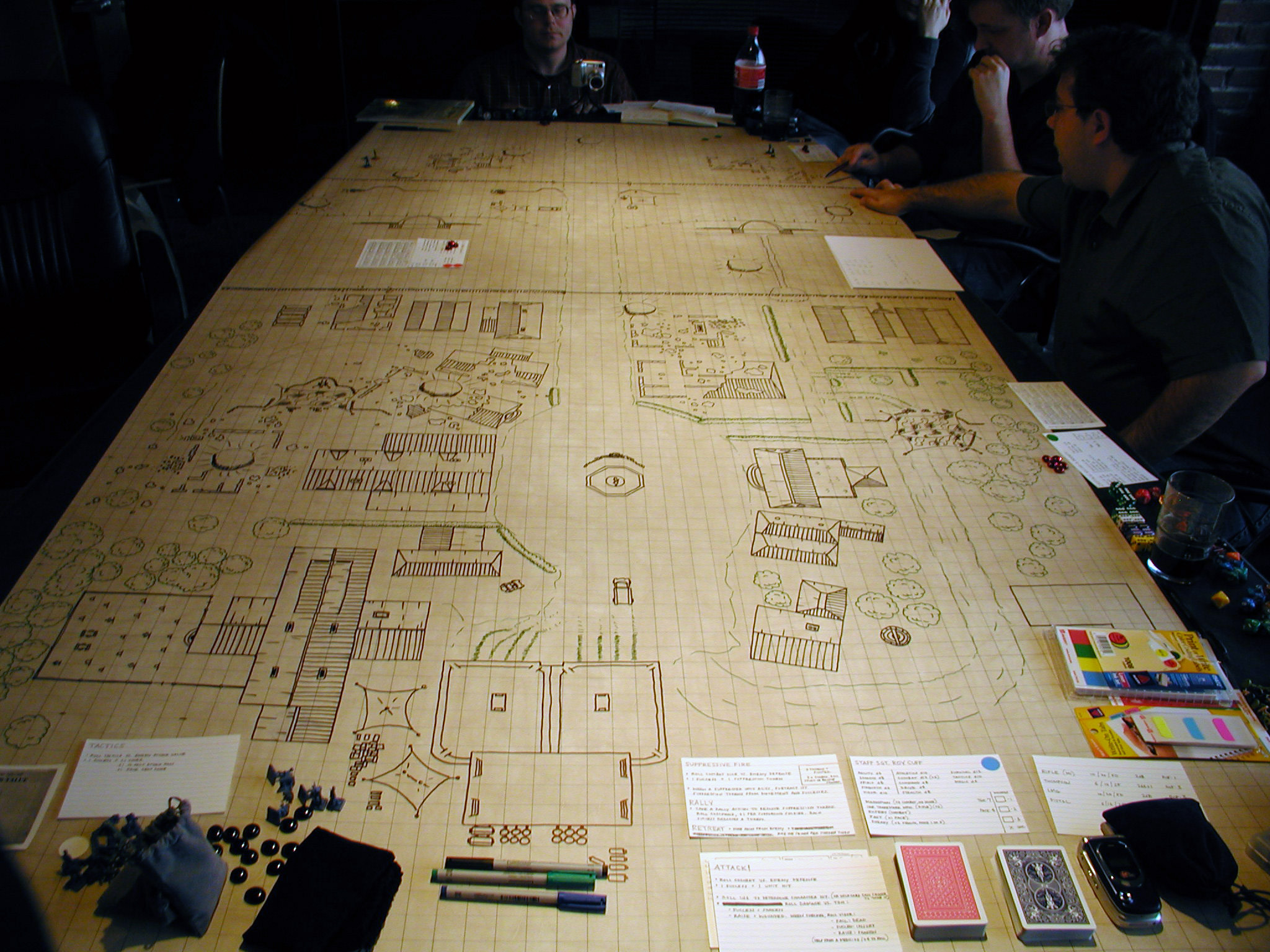
(click for full size)
It was a big ol' Savage Worlds WWII battle extravaganza. I wrote about it in detail over on Story Games if you're curious. There are also lots more photos over on Johnzo's blog. In short, it was a great success and now I have a giant 5'x8' battlemat just begging to be used again.
In addition to RPGs and boardgames, I've been playing four video games recently: Company of Heroes (PC), Splinter Cell: Double Agent (XBOX), and Rainbow Six: Vegas (PC). I'm really enjoying all of them -- they're all very well designed, game-play wise. I'll probably write mini-reviews of each in the coming weeks, but feel free to ask questions in the comments here if you like. I just got Elite Beat Agents for the DS as a gift and I'm looking forward to that, too (who doesn't want to fix the world's problems with funky dance moves?).
I'm still very much in love with BattleLore, but now I'm eyeballing Combat Commander: Europe as the next step up the wargaming ladder. It looks so good. Tide of Iron may be a contender, too. I'm just totally in the WWII gaming mood right now.
Labels: gaming
Preach it
Friday, August 18, 2006
Tycho of Penny Arcade said this today:The conditions must be right to enjoy it. We knew what those conditions were, and undertook measures to create them.He's talking about a video game, but damn. That is some crucial shit for all game players. What are the necessary play conditions for your current game? Are you creating the conditions you need to play?
Also, Mike Mearls said this on his Live Journal:
Both Agon and Burning Empires were held up at work today as examples of the cool RPG stuff at GenCon.Where "work" equals "Wizards of the Coast D&D Development Team." OMG. Awesome. He goes on to say, "The Forge booth was (accurately) identified as, 'This is the place to look for cool new games.'" And he's right. I bought 14 new games at the Forge booth alone, and they are all wonderful.
Labels: gaming, rpg theory
Goodness
Monday, May 22, 2006
I haven't been inspired with a topic for the blog lately, so here are some good things from around the neighborhood:The Durham 3 Podcasts
Clinton, Jason, and Remi are making these amazing podcasts. They talk about the game they're playing, usually before and after the session. They're short, punchy, and full of wisdom. Check 'em out.
Ron Speaks Wisdom
Ron has some really good D&D threads at the Forge now (one and two). They're well worth a read. Here's one really cool thing from the second thread. Ron's talking about how the DM might handle an Intimidation roll against an NPC called Ugly Pig the Bandit:
Ugly Pig's mind is as stubborn or as pliable as the DM fancies him ... and that fanciful quality may not be subject to revision. If the DM deems him "stubborn as an ugly pig," then dude, you're shit out of luck - because the DM may be working from intended results rather than parameters for conflict.
It's the last bit that is particularly awesome. I bet some of you are nodding your heads ruefully right now. How many GMs have we had that did that? How many times did we do it ourselves? Working from intended results... yep that was what happened, and how painful it was.
UPDATE: I totally forgot one of the links! Doh.
Breaking the Ice: Bruce and Clark
I've always loved Batman/Superman crossover stories, but generally dislike "slash" fiction. However, this game of BtI that Alexander posts about is just downright amazing, on several levels -- mainly that a fun and functional RPG can really produce awesome relationship/dating stories, with limitless variations.
Labels: gaming, rpg theory
An Objection
Monday, December 19, 2005
"Your game design does not exactly recreate the kind of fun play that my group is already doing therefore it is of no interest to me.""Your game design does not exactly recreate the one kind of play that I define as 'role playing' therefore it is a bad design that no one will like."
These are the same objection, really, just said in different ways. The first way is understandable and clear. The second way makes you sound like a jackass.
My new year's resolution is to treat people who say the second thing more like I treat people who say the first thing. Buddha give me patience.
Labels: gaming
Good Solid Gamism
Monday, November 14, 2005
Mike Holmes has some crucial things to say about good Gamist play, over here at the Forge.Pretty much everything Mike says is also true of good Narrativist play, too. The main point is simply this: know what your game is about, and then deliver those moments of decision-making to the players. Don't present false decision points, or "filler."
"What do you do now?" is one of the most dangerous questions a GM can ask, when it comes to facilitating coherent play. That question needs to be asked from within the framework of a proper scene, where "proper" means, "the preferred space in which game-appropriate decisions can be made."
Mike's example is a good one:
Asking "What do you do now?" when the party encounters an intersection in the dungeon can be a good GM question when the game is about navigating dungeons and getting out again alive.
In the same game, asking "What do you do now?" when the party is in town is probably a recipe for disaster as everyone goes wandering off "doing things" that have nothing to do with the stated goals of play. That's when you see players fidget and roll their eyes because Fred is "wasting time" haggling with merchants and getting his armor dyed green.
Good Gam and Nar play demands a GM that can cut from scene to scene so that players area always presented with "What do you do?" questions that support the goals of the game at hand.
Labels: gaming, rpg theory
People vs. Furniture
Thursday, October 20, 2005
First, Stranger Things is late going into the edit phase. This is entirely my fault (though I do blame Blizzard somwehat). I'm going to send the current draft to Phil tonight. We're not going to hit my dream-date of Halloween for release, though. Oh well.Now, to the point of the post. Ron has posted a very tasty little thing over in Vincent's forum on the Forge. I'll quote him here:
Basically, divide up everything the characters deal with into "people" and "furniture." The tricky part (to a gamer) is that sometimes things like "the door" or "the pit" or "the mountain" are people, and sometimes things like "the soldier" or "the messenger" or "the chambermaid" are furniture.
But once you have that distinction down, then it's easy: when a player-character has a conflict of interest with a person, then it's time for dice, or more properly, for resolution.
"We must get past this terrible mountain" is not a conflict ... unless the mountain is a person. Do we ever call it a person? Nope. But if it plays that role in our minds, then you're going to have great conflicts. If the conflict of interest with it can be thought of in human terms, as in "this mountain is a dreadful, ruthless place," then great! Or more subtly, if the mountain's features prompt what is called, in Primetime Adventures, character issues, then we're all good to. In play, you (we, I) should be asking the same questions of ourselves regarding the local lord in the local castle.
But if the mountain is furniture? Then it doesn't matter what you roll, how many times, or what risks to the character sheet's numbers it poses, applying the resolution procedures is horrible and boring for everyone. The same applies if we're talking about the local lord in the local castle - because he might be furniture, and if so, then I'd rather go wash the dishes or clean out the shower trap than spend one minute applying the resolution procedures to interacting with him.
If you're ever unsure about which might apply in a given situation during play, simply do a little Color for the relevant person or thing, and see what the other people at the table say. Their responses will tell you, straight-up, with no ambiguity.
Oh man... do I ever know what he means. I bet you do, too. How many games have we played in which our characters were forced to make endless climbing rolls just to get to the gorram adventure? Or wander around for hours talking to furniture NPCs? Yick. Thankfully, those days are pretty much over for me. I just don't put up with that kind of thing in my play anymore. But as a GM, I still have to really be on my A-game to keep this crap out of the game. A clear reminder like Ron's is like gold to me.
He also has a follow-up which is pretty good, too.
Labels: gaming, rpg theory
What Game Was That? Redux.
Monday, October 10, 2005
A couple of posts down, I talked about how our play of Godlike intersected with the actual written rules. I knew there was something I meant to link to regarding that post, but until today, it slipped my mind.Anyway, Vincent has a killer explanation of this whole concept, with animated GIFs and everything. Check it out: Rules and System, Periodic Refresher.
As usual, he says it all in a very clear and friendly way.
UPDATE: Vincent continues to be mighty in this thread at The Forge. Here's the relevant bit:
...Anybody can create some isolated resolution mechanics, slap on a setting, and say "here you go! You figure out what to do with them! If you have fun with them, good job, it's not my fault!" That's a pretty crap game.
As far as I'm concerned, a well-designed game forces me and my group to play in a way that a) is fun, but b) we wouldn't have come up with on our own. It makes us adopt a whole new set of general procedures, a whole new way to play.
Otherwise - look, the kind of fun my group comes up with itself? We can have that kind of fun whenever we want. We don't need any new game to teach us that.
Hell yeah.
Labels: gaming, rpg theory
What game was that?
Wednesday, September 28, 2005
First, go read Chris Chinn. If you're not reading Deep in the Game, you're missing the boat.Now, remember Godlike? Brother, I do. I ran about 20 sessions of it, most of those with a stable group of players in an ongoing campaign. We had so much fun. I was going to say, "Godlike is a fun game," but you know what? I really don't know if that's true or not. Because I'm really not sure if "playing Godlike" describes what we did in a meaningful way.
Let me put it another way. We were all looking at Godlike character sheets. And we used the game system constantly. It told us if bullets hit, and how much damage was done, and what effects the talents had, and if someone broke under the pressure of war. But the game that we were all enjoying? That was something else.
See, the system in Godlike behaves like any fine sim-supporting system should: it resolves actions taken by the characters in the imaginary world. But that's all it does. There's really nothing else in the book, other than some awesome color text and stats for all kinds of gear. But, like, what happens when we play? What's the point of the game? What are we doing together, as players? Nothing explicit about that.
So, like any good GM, I made all that stuff up, based on my own interests and the feedback of my players. We designed our own WWII simulation game, using Godlike to resolve the tasks. I know for a fact that this is what every other Godlike GM did, too -- since instructions for how to play the game are not in the book.
I can't tell you that we had fun playing Godlike. We had fun playing the game we created together, using the Godlike engine. If you pick up the manual for that engine, and make your own game for it, I can't guarantee that you will have an experience that was anything like ours.
The fun, you see, was in the stuff not in the book. The game we made together. Sure, the Godlike system supported our game, but it was not "the game." The real game was an elaborate simulation exercise, pitting the combined brain-power of the players against the German army, as portrayed by a sophisticated AI (me, the GM). I did tons of research on the real world units, and used their actual historical deployments to determine unit strengths and positions. I ran the bad guys using period fix-and-flank tactics. I was the objective, uncaring "world" around them, ready to snap its steel jaws and devour them if they screwed up.
In short, it was as close to war simulation as you can get without wearing a costume and getting rained on. And, most importantly, it was a battle of wits. The wits of the players against the cold, hard facts and some situational awareness provided by the GM.
"Godlike," as a published game, was not the game we were playing. It was a jumping-off point. A skeleton that we built a complete game on. I know that everyone in that game would agree that Godlike was important to our play, but we could have flipped coins or done RPS to check bullet hits and the overall play experience would not have changed much at all.
So... what game was that? I look at the Godlike book, and there's nothing about our play that contradicts it. Our game was certainly Godlike, as we understood it. It was also a unique instance. It's not portable. That's why I can't tell you to go buy Godlike and play it because it's fun. Only 20% of the fun came from what's in that book. The rest was me and my players, and I don't think you can purchase us at your local game store.
But what if I wrote down what the players and I did to make our game. What if I wrote out all the steps as procedures that you could follow to make your own functional WWII simulator. And what if I left out any system for determining bullet hits or morale checks and just told you to flip a coin or do rock-paper-scissors or something. Would that be a complete game that you could play to get an experience similar to ours?
I submit that the answer is yes. Which begs a question. Comment away.
Labels: gaming, rpg theory