












Fate Hacking
Tuesday, March 18, 2008
I'm working on a game using the Fate 3.0 (SotC) engine. Here are my changes so far:- Characters have 1 Fate point by default (and refresh to 1). You earn Fate mainly from Compels.
- You don't have to spend a Fate point to avoid a compel. You just miss out on earning a point.
- Fewer Aspects per character. Maybe five.
- Fewer skills per character. Maybe five.
- Apex skill level at Great. Maybe. Want to encourage aspect tagging as the primary means of being Superb/Legendary.
- Zone combat tweaked to play more like Red Box Hack.
- Assess and declare actions simplified/merged/cut. They're really just specialized Maneuvers, anyway.
- Shorter stress track. 3 boxes by default. Consequences need to be more frequent (they're a good source of compels for effect and Fate earning).
- Power Up! When you have taken all three Consequences, you get something cool. 3 Fate, a free aspect placement, +2 to your rolls, or the other PCs each get a Fate, or something. Maybe you get to pick. The key idea is: getting into trouble is good.
- Simplified stunts. Very simplified, taking the "core stunts" of SotC as the base.
- Character change! You can "burn" an aspect for a Fate payoff, which destroys it. You get to replace it with a new aspect based on events from play. There might be a per-session limit on burning.
- Include extended contests from Fate 2.0.
Cool SotC Trick
Monday, May 28, 2007
Fred Hicks said something awesome over on Story Games, in a thread about a SotC scene involving a time-distortion device strapped to the front of a zeppelin. The question was how to make dealing with the device more interesting than a simple roll. Here's his response:You could always give [the device] a stress track (you have to do "engineering attacks" to take it out) and have each consequence the players inflict on the device become a new scene aspect that, I dunno, throws weird time distortion effects into the zeppelin.This is gold. I'm posting it here mainly for my own future reference.
*bzzrap!* Suddenly the monkey minions have ray-guns from the future! *bzzzrap!* Now the Zeppelin is slowing down, but jumping around in time -- is that a dinosaur I just saw fly past the window? *bzzzzrapp!* Sparks flying everywhere! There's two of everyone! Crap, I need to fend off my mirror-mirror evil double! Someone take out the device quick!
SotC Hack #3: More Consequences
Wednesday, May 23, 2007
This is another stress track hack.I like Consequences. They make damage more flavorful, AND they're aspects, too, so that rocks. The default SotC stress track and damage system makes heroes extremely tough and hard to hurt -- which makes sense for pulps -- BUT this means they don't have to take consequences very often. I want to increase the frequency of consequences and also make conflicts a bit faster and more decisive.
To do that, I changed the stress track to a tweaked version of one Fred proposed for the upcoming Dresden Files RPG.
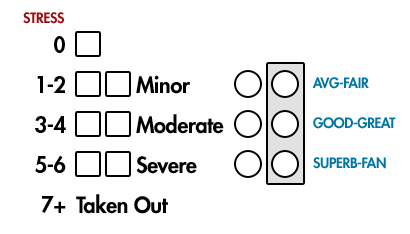
Each level has two boxes. When both are hit, you take the consequence at that level. So, if you take two '3' stress hits, you take a Moderate consequence.
Having high Endurance doesn't add stress boxes, it lets you take more consequences before being taken out. The right side of the graphic -- the circles -- shows this. By default, you can take one of each consequence (then the next one takes you out). If you have Average or Fair Endurance, you can take an extra Minor consequence. If you have Good or Great, you can take an extra Moderate (as well as an extra Minor). And Superb or Fantastic gives you one extra consequence at each level.
We tried this out last night and it worked great. Conflict was fast and furious, and we started taking consequences (I took a Severe early on). It seems to work just the way I wanted it to. If you want faster conflicts, this might be the thing for you.
SotC Hack #2: The Aspect Toss
Tuesday, May 22, 2007
This isn't a hack so much as a twisty application of the rules.You can do a maneuver to declare a new aspect, right? And then you get a free tag on that new aspect, which you can pass to another player. This is one of the core activities during conflicts.
But what if you want to do the same with one of your own aspects? Well, you should be able to. Just do the maneuver as normal, but instead of placing a new aspect, you "toss" one of your existing aspects into play. You set up a free tag on this aspect, and that free tag can be passed to any other player or used by you.
This helps avoid "aspect bloat" in a scene and is a way for players to highlight the existing aspects of their characters without having to spend Fate (you "spend" a maneuver instead).
SotC Hack #1: Zero-shift hits inflict stress
Sunday, May 20, 2007
Time for Spirit of the Century hacking!First up, we'll deal with getting zero shifts when you attack. In a normal contest roll in SotC, you only need to match your difficulty level (i.e. get zero shifts) to succeed. In combat, however, just matching the difficulty does nothing. The stress you do equals your shifts, so zero shifts = zero stress.
I don't like this.
So, here's an easy fix. Just add a "zero box" to the stress track, like so:

Now, when you do zero shifts exactly, you mark the '0' box, just like you would mark the '1' box if you got 1 shift. If you get zero again, the damage rolls up, as normal.
You can flavor this to taste. If you think a zero shift attack is worth less than a 1 shift attack in terms of damage, add several '0' boxes to the track. Like this:

This way, damage will only start to matter after several zero shift hits.
Spirit of the Aether
Wednesday, April 25, 2007
Seven months ago, I reviewed Spirit of the Century. Since then, I've done a one-shot and some chargen sessions, which were mad fun. Tonight, we start a full-on SotC series. Woo hoo! I'm so psyched.We're using SotC to continue our now-epic pulp adventure series, which began many years ago as Pulp d20, then transitioned into The Shadow of Yesterday (Tales from the Aether) and The Dictionary of Mu. Now, we finally come home to the ultimate pulp game system in SotC. I am filled with glee.
I also get to play my favorite RPG character, Nick Timber. He's from the original Pulp d20 game, and it's been a blast updating him for TSOY and now for SotC. Brandon, the GM, is using my sorcerer character from Mu (Kai Shira Khai -- Black Radiance of the Wastes -- Lord of Science) as the big villain for the new series, which will be extra special fun for me, too.
Only five more hours 'til the game...
UPDATE: I posted a mini-AP thing over on Story Games. I'll do more APs for the game as it goes on.
Labels: FATE
Spirit of the Century Review
Monday, September 18, 2006

Spirit of the Century by Evil Hat Productions
6x9 hardcover, 420 pages
Rating:


Recommended Purchase
First, this is the pulp RPG you've always wanted. You know who you are. You don't need to read this review. Just go buy it.
Now, let's talk about the book. I haven't played the game yet, so this is a review of the book and its concepts, not of actual play. My short review of the book is, "Solid gold and white noise." I'll explain what I mean by that.
Solid Gold
Spirit is filled to bursting with good ideas. Every core game design element just sings. Character creation, conflict resolution, adventure design... it's all brilliant and perfect for the type of pulpy goodness the game wants to create. I really can't praise it enough. I know my pulps, and this game gets it right. A few of the high points...
Character Creation
The multi-phased character creation (similar to the method in FATE) establishes a great pulpy feel for each character, by focusing the player's creative energies on a classic "origin story" for the character. It even includes a phase in which you create your hero's pulp novel, which also ties-in to the other PCs and provides traits for your character based on the action from the novel. It's super cool.
The skill pyramid (also from FATE) is another very clever system. Each character has a single primary skill at Superb (the thing they're best at). Then below that you have two skills at Great, three at Good, four at Fair, and five at Average -- forming a "pyramid" of skills. This visual representation makes character creation a snap. Instead of spending "levels" or character points, you just fill in the blanks on the pyramid.
Aspects
In addition to skills (which are picked from a list), characters also have Aspects (like "Nick of Time" or "Loves Sally"), which are created by the players. These are qualities -- relationships, beliefs, catch-phrases, items -- that can be activated for bonuses when they help, or farmed for Fate Points (a metagame resource) when they hinder the character. They're like a combination of Keys from TSOY, Muses from Nine Worlds, d4 traits from Dogs, and disads from HERO. In short, they are awesome. Having player-authored character traits in addition to the skill-list picks really helps the pulp feel since each character has something in common with the other heroes AND some stuff that's unique and quirky of their own.
And, even cooler, aspects are not just for PCs. NPCs have aspects, as do locations and things in the game. A lost temple might have aspects like "deadly traps," "dark corridors," and "lava pits." Players (and the GM) could activate these aspects during a conflict to help their character or hinder someone else. Players can also perform maneuvers to place temporary aspects on a foe, like "blinded" or "on fire." This is a *very* elegant way to handle the impact of tactics, environment and color details on a scene. Aspects are probably the coolest thing about the system, period.
Conflict Resolution
Speaking of the system, resolution is a snap. Spirit uses a new version of the FATE system, which is based on Fudge. You roll four Fudge dice and then modify your trait level accordingly to find your final result. If you match or beat the difficulty level, you succeed. For extended conflicts, you put "stress" on your opponent when you win a roll, and the conflict ends when the someone runs out of stress (and starts taking serious consequences) or gives up (to avoid those nasty consequences). It's nice and simple, and can handle all sorts of conflicts. And it's cooler than I make it sound. I'm glossing over some stuff because this review is already longer than I planned.
Examples, Examples, Examples
So, why is this simple pulp rpg 420 pages long? Because the book tells you how to play the game. Often. Aggressively. With flair. The book doesn't just have "examples," it has a mission of relating everything it says to real, at-the-table play. Ramifications are spelled out, possible hurdles are addressed, "why it's cool when you do this" is explained in detail. For this reason, Spirit has become my new pick for "first RPG" for people who are already gamers of some stripe (board, card, whatever). It's crunchy enough to interest them, and it explains how to play (and why) really, really well. (For the record, the best "first RPG" for non-gamers is a tie between Primetime Adventures and Shooting the Moon. So, good company.)
Adventure Creation
Three different methods of creating pulpy situations are given in the book. And one of them is super-mega-awesome. The adventure section in general is awesome, and addresses everything a GM needs to get a Spirit game up and running, probably with a minimal amount of time and effort expended. The game bills itself as a "pick up and play" sort of game, and there are plenty of good methods presented to make this happen. The ultra-quick PC generation method, for example, is genius. It's so good, I'd probably use it for standard play, as well. Like Fred Hicks's other game, Don't Rest Your Head, Spirit helps the GM by telling her precisely how to drive the game by using the stuff the players have written on their character sheets. This has become something of a trend in design, and I'm very happy to see it explained so lucidly here.
White Noise
So, what's this "white noise" I'm talking about? In general, it comes from Spirit's attempt to cater to lots of different play styles. There are many places where the book bends over backward to accomodate three (or five) styles of play at once, and as a result, some of the good stuff in the book is hidden by a layer of "white noise" -- backpedaling or undercutting to make the system less radical or in-your-face. This is not really a bad thing at all. I just happen to prefer a more direct, uncompromising voice in game books and when Spirit gets wishy-washy, I notice it. This may be a result of having multiple authors, since Fred's own game, Don't Rest Your Head doesn't have any white noise at all.
Here are some examples of what I mean:
Fate Points: The game has solid rules for how Fate points can be spent and gained. They are clear and unambiguous. However, each explanation is accompanied by phrases such as "If the GM approves," and "If the GM thinks it's appropriate," which are just white-noise static to me. There's no need for this "mother may I" phase in the system. The game works perfectly without it. Thus, "white noise." The need to cater to "GM approval" for so-called "metagame" systems is a feature of old-shool game design that is just not serving a useful purpose in a game like Spirit. As I said, the rules for how Fate works are perfectly solid and clear. Any use of those rules can be "approved" or not by the group, just like any other system.
Resolving maneuvers: Again, there's a solid system for this, including a way for players to use action rolls to add or remove aspects from a scene. It's very cool. Then we get a phrase like this, "Whatever the result [of the roll], the GM can decide whether or not the change the character makes merits adding or removing an aspect to the scene." More white noise. There's a solid, good game system here, and then we're told that the GM can ignore it and just say what happens. Wha? The addition of the "GM decides" sentence adds static to an otherwise clear passage. The system is solid and really, really good. There's no reason to backpedal and throw it all back out to GM fiat.
That's probably enough to show what I mean. I don't want to belabor the point. Like I said, this "white noise" is mostly harmless for most readers. (Though for first-timers, I worry that it could start some bad habits). The book would certainly be better without it, but it doesn't detract all that much.
The End
So, that's my take on Spirit of the Century. It's one of the best traditional RPGs I've read in a while (I mean "traditional" as in, "has a single GM and non-shared PCs"). It's by far the best design for pulp-gaming ever made (and that is a huge compliment, considering some of the other games that have come before).
I give it an A. It's a must-buy. Go. Get it. Play. Be rocked.