


Apocalypse World: Crossing the Line
Tuesday, October 26, 2010
I'm seeing a trend in some of the custom moves people are making for Apocalypse World. Basically, some moves are "crossing the line" regarding what the players' role is and what the MC's role is. I think it's a bit of a problem, so I'm writing this post to lay out my thinking.The Line
In Apocalypse World, the players are in charge of their characters. What they say, what they do; what they feel, think, and believe; what they did in their past. The MC is in charge of the world: the environment, the NPCs, the weather, the psychic maelstrom.
Sometimes, the players say things that get very close to the line. Usually this happens when the MC asks a leading question.
MC: "Nero, what do the slave traders use for barter?"
Player: "Oh man, those fuckers? They use human ears."
That's a case of the player authoring part of the world outside their character, however -- and this is critical -- they do it from within their character's experience and frame of reference. When Nero answers that question, he's telling something he knows about the world.
Compare that exchange with this one, which is crossing the line:
MC: "Okay, Nero, so you get the box of barter away from the slave traders and haul into the back of the truck."
Player: "Cool. I open it up."
MC: "Okay. What do you see when you open it?"
Player: "Um... uh, a bunch of severed fingers?"
See the difference? In the first case, the MC is addressing the character and asking about some knowledge he has. In the second case, the MC is fully turning over authorship of the world in-the-moment to the player, which is not part of the player role in AW.
Moves That Cross the Line
So, given that, we can look at a custom move and see if it's crossing the line. Is the move asking the player to fulfill the authorship role of the MC? In my opinion, if the answer is 'yes', it's not a good move. Let's look at some examples.
Here's a custom move from the book that approaches the line:
When you go into Dremmer’s territory, roll+sharp. On a 10+, you can spot and avoid ambush. On a 7–9, you spot the ambush in time to prepare or flee. On a miss, you blunder into it.
At face value, it might look like the player is authoring the world in-the-moment, determining if there's an ambush or not. But this move is rooted in what the character does and the effect it has. By making this move, the player isn't deciding what Dremmer and his people do, that's the purview of the MC. The move is determining how well the PC deals with what Dremmer already has in motion (i.e. lying in ambush for trespassers).
For contrast, here's a custom move that crosses the line:
When you try to deal with the rat-men, roll+hot. On a 10+, they'll listen to what you have to say. On a 7-9, they'll listen, but choose 1:- they're drug-crazed and seeing visions
- they're arming up for war on the tunnelers
- they're starving for blood and demand some right now
See how that move asks the player to author the game world in-the-moment? There's no opportunity for another player to have any say. The player says what they do, then rolls the dice, then says what the NPCs do, then says what he does about it. Not only is this crossing the line into the MC's arena of authorship, it's also a huge bore for everyone else.
See how that move asks the player to author the game world in-the-moment? There's no opportunity for another player to have any say. The player says what they do, then rolls the dice, then says what the NPCs do, then says what he does about it. Not only is this crossing the line into the MC's arena of authorship, it's also a huge bore for everyone else.
In various custom move threads around the web, I'm seeing moves that cross the line like that. They ask the player to initiate the action and then also author the outcome. That structure makes for a boring move and also a confused player who's asked to do things that fall under the MC's role.
Here's a simple fix that improves that move:
When you try to deal with the rat-men, roll+hot. On a 10+, they'll listen to what you have to say. On a 7-9, they'll listen, but the MC chooses 1:
- they're drug-crazed and seeing visions
- they're arming up for war
- they're starving for blood and demand some right now
That's pretty obvious, right? Instead of the player choosing what the NPCs do, the MC does (I also dropped 'on the tunnelers' from the war choice, so the MC can decide in-the-moment who the rat-men are going to fight).
Here's another way to do it, with the player still choosing, without crossing the line:
When you try to deal with the rat-men, roll+hot. On a 10+, they'll listen to what you have to say. On a 7-9, they'll listen if you prove yourself. Choose 1:
- you consume their vile drug and have visions with them
- you give them some intel on their enemies
- you let them taste your blood (1-harm ap)
Similar choices, but all written as actions the character takes.
Hopefully that all makes sense. "Crossing the line" isn't the end of the world in a custom move, but it's something to be on the lookout for. Keeping moves on the player-role side of the line will help make them sharper and stronger in play.
Labels: apocalypse world, rpg theory
[AW] Seize by Force is a Peripheral Move
Tuesday, November 23, 2010
It took me 80+ sessions of Apocalypse World for it to sink in, but there it is. Seize by force is a peripheral move, not a basic one.It's one of the least-used moves in the game (or it should be). The fictional actions it represents are unusual to the point of almost never happening. Virtually every situation where seize may come up is better covered by a combination of act under fire and go aggro (plus some of the optional battle moves, occasionally).
In the rare case where a character really is just charging forward to their goal with no concern for their own safety, the move works great. Maybe it should be called walk through the fire or something.
Seize also muddies the waters really badly for some players. Any time a character goes after a goal, it's interpreted as "seizing" a thing, and the move is rolled -- even when the outcomes and effects of the move make no sense for the fictional situation. The last AW game I played in was plagued by repeated discussions about whether an action was seize by force or go aggro. It was go aggro, every time (with some acting under fire sprinkled in), but the fact that the seize move was there in front of everyone turned a simple action into a rules debate. It was tiresome.
Bits in the text about "seizing the moment" or "seizing a life" confused things all the more. I know what Vincent was going for there, but in practice it's confusing as hell.
So, goodbye, seize by force! You're getting cut from the basic moves sheet. Enjoy your new company with the peripheral moves. I'll see you around some time.
Labels: apocalypse world
Apocalypse World: Guide to Hard Moves
Wednesday, May 18, 2011
I keep seeing some people struggle with this, so here's a handy guide to hard moves in Apocalypse World.When you make a regular MC move, all three:
1. It follows logically from the fiction.
2. It gives the player an opportunity to react.
3. It sets you up for a future harder move.
This means, say what happens but stop before the effect, then ask "What do you do?"
- He swings the chainsaw right at your head. What do you do?
- You sneak into the garage but there's Plover right there, about to notice you any second now. What do you do?
- She stares at you coldly. 'Leave me alone,' she says. What do you do?
When you make a hard MC move, both:
1. It follows logically from the fiction.
2. It's irrevocable.
This means, say what happens, including the effect, then ask "What do you do?"
- The chainsaw bites into your face, spraying chunks of bloody flesh all over the room. 3-harm and make the harm move!
- Plover sees you and starts yelling like mad. Intruder!
- 'Don't come back here again.' She slams the door in your face and you hear the locks click home.
See how that works? The regular move sets up the hard move. The hard move follows through on the threat established by the regular move.
I've seen people struggle with hard moves in the moment. Like, when the dice miss, the MC stares at it like, "Crap! Now I have to invent something! Better make it dangerous and cool! Uh... some ninja... drop out of the ceiling... with poison knives! Grah!"
Don't do that. Instead, when it's time for a hard move, look back at the setup move(s) you made. What was threatened? What was about to happen, before the PC took action? Follow through on that. Bring the effects on screen. Bring the consequences to fruition.
And speaking of consequences, a hard move doesn't automatically equate to severe consequences. The severity of the threat is a separate issue, depending wholly on the fiction as established. The hard move means the consequences, large or small, take full effect now.
It's not about being mean, or punishing a missed roll, or inventing new trouble. It's about giving the fiction its full expression. Setup, follow-through. Action, consequences.
Labels: apocalypse world
The Regiment: Colonial Marines 2.5
Saturday, February 09, 2013
The version 2.5 playtest kit for The Regiment: Colonial Marines is ready.
GOALS FOR 2.5
A slightly simpler game: I reduced the overall number of moves as well as removing some exceptional cases so it’s easier to remember and apply rules.
Fictional results for stress and wounds: In previous versions, it was easy to gloss over the effects of stress and wounds, falling back on shorthand: “Take 2 wounds.” I wanted each box of damage to have a specific effect to cue a result in the fiction.
More difficult choices: Tough choices are always fun. I revised the old push yourself move into something more interesting (I hope): Keep it together. The engagement move now accounts for details of the specific situation, including morale elements, so choices of fictional positioning have a bigger impact when making that move.
CHANGELOG
New volume of fire table: There are now 5 VOFs: Incidental, Scattered, Direct, Focused, and Concentrated.
New stress system: Each time you take stress, you choose how your solider will react to it: Flight, Fight, or Shock.
New wounds system: Wounds have locations now, and critical wounds take you out of action. There’s a critical move that determines how badly you’re injured, so there’s more uncertainty (you can’t count on a 2d pistol to not kill you).
New and revised moves: Assault now includes covering fire. Push yourself has been revised into keep it together. Help has been revised into aid. Hit the deck no longer requires a roll. New critical move. Rally is now a Sergeant move.
New and revised playbook moves: Changes to each playbook! Give them a close look. Also check out when you mark xp (upper right corner of playbooks).
Thanks for checking it out! If you give it a try, let me know here, on G+, or at the Regiment forum. As always, I'm happy to answer questions.
Labels: apocalypse world, hack, regiment, rpg
Tenra Bansho Zero (GenCon AP)
Monday, August 27, 2007
I got the chance to sit down with Andy K and some other folks to play Tenra Bansho Zero at Games on Demand at GenCon 2007. The verdict: crazy-ass, over-the-top, anime-style weirdness with a really kickass game system driving the whole thing.Andy had pregens for us to choose from, which was not only a good choice for a one-shot at a con, but also somewhat reflects the actual character creation system. In the full game, you choose two to four archetypes and mash them together to get all of your stats and skills (then customize a bit). I've always been a fan of that chargen method, and I think it suits the setting and style of the game well.
I got to play a Kongohki (金剛機), which is Tenra's version of Robocop. A Shinto priest captures a soul from the netherworld, scrubs off its identity, and then sticks the soul in a magic mirror inside a robotic body. ("Kongoh" is the Japanese word for Vajra, and is used here to mean 'unbreakable substance'.) The best part of being a Kongohki (aside from doing cool robot stuff) is the flashback mechanic. Whenever you get 5 aiki chips (which are kind of like Fan Mail from PTA) your Kongohki has a flashback scene of its former life. We decided my soul was that of the wife of the Samurai PC, who had died in a fire long ago. After the first flashback, I started using the pet-name for the Samurai (Katsu-chan) but otherwise acted as if I remembered nothing. This created a very bizarre and fun love triangle with me, the Samurai, and the creepy insect-nanotech girl.
The game has a lightweight and speedy resolution system, mostly focused on task-based stuff and combat. Combat is very easy to handle, supports crazy over-the-top stunts and cool moves, and resolves quickly, even in the big boss showdown we had. The real meat of the system, though, is in the economy of aiki chips, Fate points, and karma. The interplay of these creates a very cool cycle of player rewards (fan mail), PC goals and spiritual attributes (Fates, which are mini Keys/Muses), and an endgame/doom/level system (Karma).
There's a lot there, so I won't go into detail. As an example, though, one use of Karma is to "balance" the various PC types in terms of raw power. Characters with massive abilities and powers start off with a lot of Karma. When you spend Fate to do super-moves (like rolling 20 bonus dice) it adds to your Karma score. If your Karma goes over 108, you risk losing your character to evil (power corrupts!). So, the real heavy hitters have to be careful about how they spend Fate and can't really cut-loose until they're ready to meet their destiny. The "weaker" character types start with less Karma, though, so they can spend Fate like mad and explode into crazy Final Fantasy style Limit Break awesome when needed. And since all of this is tied back into the Fan Mail system and PC goals/relationships, it neatly sidesteps any "mother-may-I" troubles that some mechanics like this fall into.
In play, the game reminded me most of Nine Worlds. The PCs were super-powerful badasses (even the weaker ones) who were driven by their goals, emotions, relationships, and destinies, which fed mechanically into the reward system and also drove the scene framing and story arc of the session.
I'm really looking forward to the completed English version of this game. The setting is wahoo-anime crazy pants, which isn't usually my style, but the system was so engaging and crisp, I'm excited to play again.
Labels: play report
The Regiment: Elements
Thursday, May 05, 2011
Paul and I are still working hard on THE REGIMENT. We had planned on a Q1 release originally, but have since decided to take more time with it and do another round of playtesting instead. Here's another teaser PDF for you in the mean time.
FAQ answer: It's an Apocalypse World add-on, not a stand alone game. You might think of it as a specific kind of apocalypse (one in which WWII never ended, and has consumed the globe) with new playbooks and moves to suit. Sort of like an AW playset, in a way.
(UPDATE: There was a typo and one of the moves needed tweaking, so I uploaded a new version of the PDF.)
Labels: apocalypse world, hack, regiment
The Western Zombies Game
Thursday, February 24, 2011
Daniel Solis recently blogged about "rolling to hit" in RPGs, and how to approach the issue in various ways. This reminded me of a game I threw together for a game-day back in 2002, so I went and dug through some old boxes and found my notes.IT DON’T END WHEN YOU BURY ME
The Western Zombie Game
Shooting
- Each d6 is a bullet. You have 6d6 in your trusty Colt Peacemaker pistol.
- When you shoot at a zombie, roll Xd6, up to the number of bullets remaining in your gun.
- The numbers rolled tell you where you hit. 1,2: legs, 3: arms, 4,5: torso, 6: head.
- A head-shot instantly destroys a zombie.
- A leg-shot slows a zombie (moves 1 instead of 2). Two leg hits immobilize a zombie (it moves zero and can’t lunge, but can still bite and claw).
- Any number of arm hits weaken a zombie. It attacks at lower strength (-1d6).
A torso-shot has no effect on a zombie.EDIT: A torso-shot blows through a zombie. Roll the die again as a hit on any target behind the zombie, up to 2 squares away.
Reloading
- When you reload, pick up a number of dice equal to the number of bullets you want to reload. The GM also picks up one die. Count down, 3! 2! 1! then you both roll your dice.
- GM: Acting like a lumbering zombie, pick up another die. Moan. Roll the die. Does it match any of the dice you’ve rolled? If it does, shout URGH! Reloading stops right now and the zombies nearest the player take a turn! If the dice don’t match, pick up another die, moan, and repeat until reloading stops.
- Player: After you roll your dice, you have to quickly pick them up again -- one at a time -- and place them back on the table with their top faces in numerical order, starting with 1 and counting up. If you do this, shout LOADED! Reloading stops right now. If you beat the GM (you shouted LOADED before she shouted URGH) then you get to shoot before the zombie(s) go.
The Map
Use a square grid map. Draw in some buildings like a western frontier town. Indicate where some weapons are scattered around, too.
A zombie can move 2 and attack.
- Zombie Claws & Teeth: Range 1. Damage 2d6.
- Zombie Lunge: Range 2. Damage 1d6, knocks target prone.
A PC can move 2 and do something (shoot, close a door, pick up a gun, reload) -or- move 3.
- Sawed-Off: Range 3. Holds 2 shells, which are d10s. Any 6+ hit destroys a zombie.
- Pistol: Range 4. Holds 6 bullets, which are d6s.
- Shotgun: Range 5. Holds 5 shells, which are d8s. Any 6+ hit destroys a zombie.
- Rifle: Range 6. Holds 12 bullets, which are d6s.
- Dynamite: Range 4. Damage 10d6, distribute hits to target square and every target adjacent.
That's all there is. I guess we figured out the missing bits, because I remember playing this and having all manner of fun. Maybe there's enough there for you to give it a try, if you have a mind to.
Anyway, to Daniel's point, there's a game that's all about shooting zombies and it manages to be tense and fun, even though you can't ever miss.
T = -1
Wednesday, June 14, 2006
It's called Agon.-----
The starting position is 4, based on terrain and visibility (large interior + bright).

After the positioning rolls, the order is (from lowest to highest):
1. Green Skeletons (armed with javelins and swords)
2. Blue Hero (armed with a bow and spear)
3. Red Hero (armed with javelins and a spear)
4. Yellow Skeletons (armed with bows and spears)
The Green Skeletons are the lowest, so they don't get to position anyone.
The Blue Hero goes next. He can move any opponent that he beat, which in this case is only the Green Skeletons. He moves them one range band closer.

Then the Red Hero goes. He can also move the Green Skeletons, so he moves them closer again, to get them into spear range (2) for both Heroes.

Finally, the Yellow Skeletons get to position. They decide to push the Red Hero away one band, putting him into their bow range (5,6) and moving him out of optimal spear range against the Green Skeletons.

That leaves us with our final positions before the action starts for this exchange.

Blue has Green in optimal spear range, and Yellow has Red in optimal bow range. Red doesn't have a bow, but he can hurl javelins at Green.
-----
The range strip kind of looks like a corridor, but it's not. It's just an abstract representation of the battlefield. Wilhelm tells me that Traveller did something like this, but I haven't played it. Brandon came up with this range strip business during our playtest last night. It seems to work really well.
Labels: agon
Apocalypse World Character Sheets
Tuesday, June 29, 2010
Here are my sheets for Apocalypse World, updated to the final version of the game.
Includes sheets for all the Basic and Peripheral moves, too.
EDIT: Updated file to the 07.06.10 version (with MC sheets).
Labels: apocalypse world
Creating Situation: Log, Map, & Spyglass
Monday, December 31, 2007
Here's the situation creation method for Codename: VALVE. The main action of the game concerns sailing the Wild Blue, exploring new places, getting into trouble, and winnning plunder. To create a situation, the players use the ship's log, their maps of the Wild, and a spyglass.The Log
First, the Captain consults the ship's log. It's printed in the book, with empty spaces after each entry for you to write some details (yes, you're supposed to write in the game book! gasp!). A log entry will briefly describe a starting circumstance for the ship and crew, like, "Crowsday, 39th of Elm. Crew sick, seeing visions. Must find a spirit healer soon." Or, "Fresh shot and powder and the guns new polished, crew spoiling for a fight."
The Map
Then, the crew picks one of the map sheets. These are navigation charts that depict a group of flying islands, with drawings of terrain and places on them, along with little notes and names for things, in the classic Tony Dowler style. Sometimes an island will be very low altitude and partially submerged in the heavyside layer.
The crew and Captain together decide where to go on the map. You're like, "We sail for the town of Silver Fall, here by the big waterfall that's going off the edge." There might be a note about Silver Fall written on the map ("Avoid the people of the Accord"). You can also check the dispatches in the book about Silver Fall. The dispatches are the scouting reports of Imperial assessors, written as brief first-hand accounts -- just enough to get your imagination going.
The crew starts out with three of the seventeen maps. More maps can be found as part of game play.
The Spyglass
Finally, someone has the spyglass. As you sail in, the person with the spyglass can look and see things. They can invent details of the place by calling out what they see: "It looks like the towers are burning!" Or they can solicit details from the other players by asking a question: "Are there supposed to be fires up in those skinny towers?" Any of the crew can respond. You can respond to a declaration with support ("On fire? The place must have been attacked by the Empire!") or with doubt, "Nah, it's probably not on fire. Those are lights to help ships land." Crew can also ask leading questions like, "Do you see any blue smoke?" or "Can you tell if the festival flags are flying yet?"
Crew can ask the person with the spyglass to check again, if anyone is obviously unhappy with what is seen. "No, that couldn't be! Check again." The person with the spyglass may pass the glass to someone else with, "Well, take a look for yourself." A crew member may also take the spyglass with, "Let me see that."
Once everyone has had the spyglass (or passed on the opportunity to have it) then you've seen all you're going to see. The Captain should note spyglass details in the ship's log.
Whenever the ship moves to a new place on the map, you check for Dangers and Opportunities. This is the "wandering monster" element of the game, which puts pressure on the crew to take their current loot and go home. They can always choose to press their luck and hunt for more loot, risking an encounter with an Imperial hunter or other calamity.
Labels: rpg, valve, work in progress
The Regiment: Alpha 2.0 playtest
Sunday, August 26, 2012
The alpha 2.0 playtest kit for The Regiment is here.
Changes from alpha 1.0:
- Single-sided, 8.5x11 playbooks. A bit simpler now and ultra-compact!
- Revised and standardized advancement across all playbooks.
- Added new modern era special forces Operator playbook.
- Completely revised moves, both in the playbooks and in the basic set.
- Revised weapon ranges and damage.
- New battle plan mechanic, similar to workspace from AW.
- New unit maneuvers mechanic, to gracefully handle off-screen and NPC actions.
Coming soon, but not done yet:
- The new Unit creation sheet. You can use the old one for now, and use "profile" for "operational effectiveness" in 2.0.
Go ahead and grab it, give it a try, and let us know what you think over on The Regiment forum.
Thanks to all the alpha 1.0 playtesters and fans for your help and support.
Labels: apocalypse world, hack, regiment, rpg
The Eye of Chaos
Wednesday, November 03, 2010
This is one of the games I'm running right now, an Apocalypse World hack for playing dark fantasy in the style of Warhammer.
The PDF has a character sheet, new basic and peripheral moves, spellcasting, and three rough character types cobbled together from AW types, Johnstone's work, and some ideas of my own. If you're familiar with AW, there's enough here to get you going if you want to try it out.
I'm pretty proud of the violence move.
Labels: apocalypse world, hack
The Regiment Alpha Playtest Kit
Monday, March 05, 2012
Here's the alpha playtest kit for THE REGIMENT, an Apocalypse World hack about soldiers at war.- Playbooks for the Soldier, Officer, Sergeant, Medic, Commando, and Sniper.
- Moves and Weapons tri-fold.
- GM toolkit tri-fold.
- Regiment/Unit tri-fold.
http://www.onesevendesign.com/regiment/the_regiment_alpha_1_0.pdf
There's a Regiment forum over on the Apocalypse World boards. Please discuss the game over there.
Thanks!
Labels: apocalypse world, hack, regiment, rpg
Holiday Gaming
Friday, December 29, 2006
Oh yes, there has been much good gaming this holiday season.First, there was Elizabeth's Holiday Game Party, which was a blast. There were 40+ people in attendance overall and many games were enjoyed. We played Transamerica, Speed Scrabble, Carcassonne, Ingenious, Cranium, and BattleLore. Mmmm... BattleLore.
Then, at the weekly game group, more BattleLore. My Dwarves gave Tony's Goblins a beating, but it was his first game, so I won't gloat too much. We have agreed to rematch at Agincourt.
Then this happened:
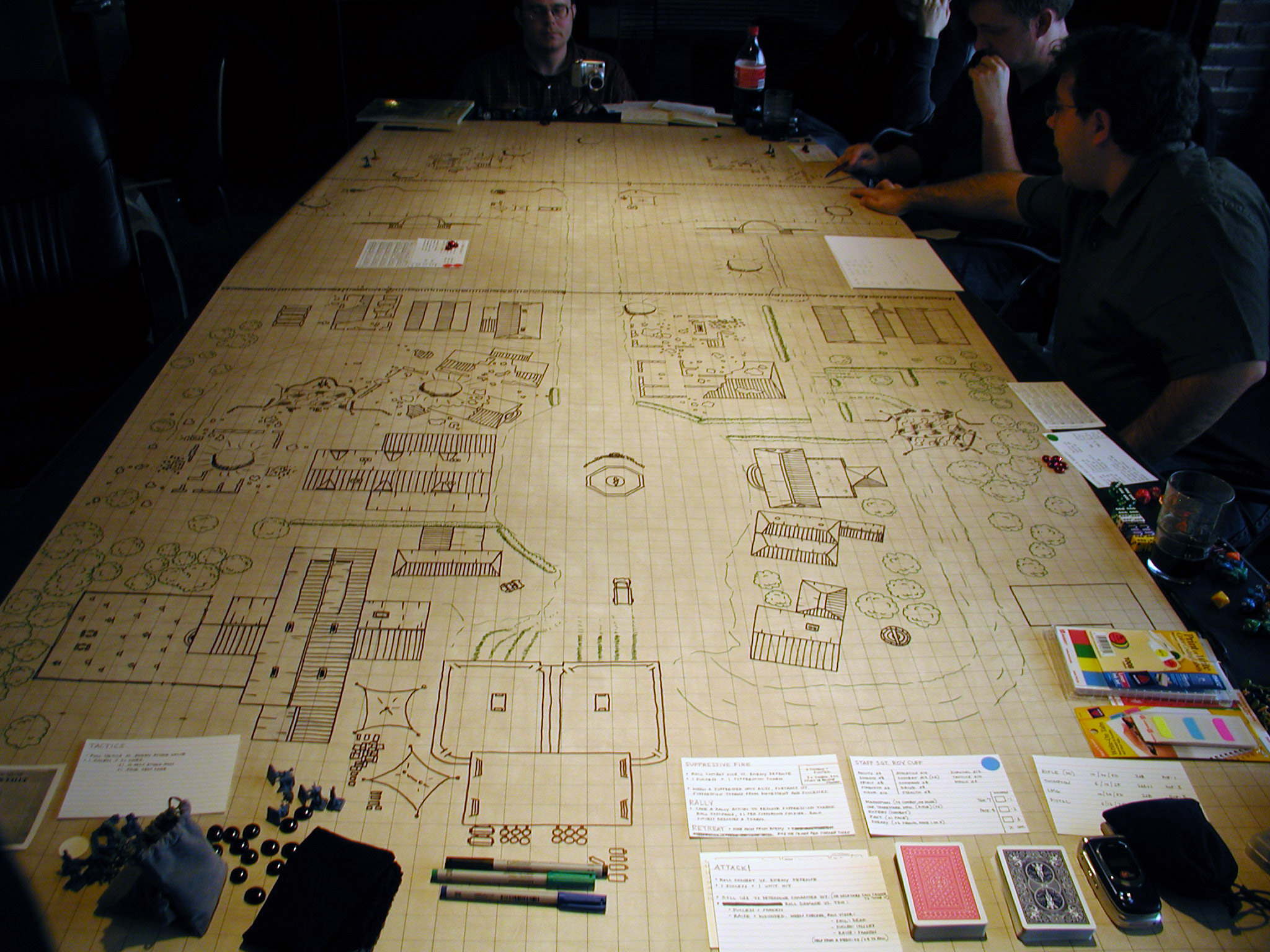
(click for full size)
It was a big ol' Savage Worlds WWII battle extravaganza. I wrote about it in detail over on Story Games if you're curious. There are also lots more photos over on Johnzo's blog. In short, it was a great success and now I have a giant 5'x8' battlemat just begging to be used again.
In addition to RPGs and boardgames, I've been playing four video games recently: Company of Heroes (PC), Splinter Cell: Double Agent (XBOX), and Rainbow Six: Vegas (PC). I'm really enjoying all of them -- they're all very well designed, game-play wise. I'll probably write mini-reviews of each in the coming weeks, but feel free to ask questions in the comments here if you like. I just got Elite Beat Agents for the DS as a gift and I'm looking forward to that, too (who doesn't want to fix the world's problems with funky dance moves?).
I'm still very much in love with BattleLore, but now I'm eyeballing Combat Commander: Europe as the next step up the wargaming ladder. It looks so good. Tide of Iron may be a contender, too. I'm just totally in the WWII gaming mood right now.
Labels: gaming
Flip (mini-game)
Tuesday, January 10, 2006
Remember The Pool? Dang, it's amazing. It doesn't get as much heat as it used to, which is a shame. The Pool is the game that really brought me into this whole "indie" thing, right before Sorcerer, Donjon, and Universalis. I ran a bunch of little one-shots with it (the Anti-Pool, to be more precise), and it just works.Anyway, lately, I've been dabbling with little pseudo-game-engines in the vein of The Pool. They're not complete games by any stretch, but they are a jumping off point for a group to construct their own little thing (by adding scene framing, situation creation, and such like). I'll be sharing them here. Here's the first.
Flip
To make a character, first write the character's name on the top of the sheet. Next to the name, write the character's concept. A concept should be 1-3 words that describe a core quality of the charcter. Like "Slayer," "Robot Flyboy," or "Dungeon Delving Wizard."Next, divide the sheet into two columns. Label one column "Experience" and the other column "Trials." Under "Experience" write down 6 positive qualities of the character. These can be things they have done, things they are known for, beliefs, relationships, or even stuff they carry around that helps them. Under "Trials" write down 3 things that make life difficult for the character. These could be unresolved personal issues, physical impairments, obligations, or bad things that happened in the past.
Anyone can call for a conflict to resolve stakes. A conflict resolves the stakes for one player-character at a time. The player of the character in conflict (the "active player") can reject the conflict (if they want to) by appealing to the character concept. "Well, I am the Slayer, so dusting this vamp is not a 'conflict' for me. Let's move on." If the active player approves, the conflict moves forward, and the stakes are set.
Stakes are set by creating a set of two possible outcomes for the conflict. One that is good for the character, and one that is bad. All the players can contribute ideas for the two outcomes. Everyone must agree to the stakes before the conflict is resolved.
To resolve a conflict, flip a coin. Heads means that the good outcome happens. Tails means that the bad outcome happens.
The active player can then re-flip the coin by activating one of the character's traits. To re-flip a coin that shows heads, activate a "trial" trait. To re-flip a coin that shows tails, activate an "experience" trait. When you activate a trait, narrate how it affects the conflict situation, for better or worse.
You can continue to re-flip until you are satisfied, or you run out of traits to activate.
Once a trait is activated, it cannot be activated again until it is refreshed. A trait is refreshed when any character refers to the trait out loud in a future scene.
Whenever you re-flip a coin that shows tails, make a mark in your "trial" column. Whenever you re-flip a coin that shows heads, make a mark in your "experience" column. When you collect 3 marks in a column, erase the marks and add a new trait to that column, based on what has happened with your character in the game.
That's the simple version, which is really just a sketch of a partial system. Notice I don't even mention if there's a GM or not.
Next, I'll post a more complex version, that incorporates obstacles, jobs, and goals into a more fully-functional game currency.
Situation, Scene, Conflict, Resolution
Sunday, January 01, 2006

Vincent, Ron, Clinton, Matt, and others have explained this idea in various ways before, but making this diagram helped me figure it out in a very concrete, practical way. A similar diagram is going in Stranger Things.
The idea is that first you establish Situation. This is the immediate situation that the character finds herself in, which also contains the larger conflict ("The vampires of Fog Alley are killing important nobles of the city."). This situation is addressed through a series of several scenes. Each scene is embedded in the situation and a conflict is embedded in each scene. By resolving the scene-level conflict, you move to the next scene within the situation. After several scene/conflicts, you resolve the current situation, which in turn moves you to the next situation. Repeat. And that's a way to roleplay.
Once I had this diagram, I was able to see all the parts, and begin assigning authority and game tasks to each part. Who says what the Situation is? How does a Scene relate to Situation? Who says when a Scene begins and ends? Who says when a conflict begins and ends? How do you know when a situation is "resolved" and how does that resolution supply material for the new Situation? All that kind of stuff.
Once you add Flags, this diagram makes it possible to draw a roadmap for a game session that a GM can actually use in play without "railroading" or employing Force to steer the events toward set outcomes.
This is remedial stuff as far as theory is concerned (it's a rehash of Dogs town creation, really), but making the diagram made it really click for me so I thought it was worth sharing. The key for me was in recognizing that all of those circles above are not just "things that happen" during a game session, but that they are game play modules that need to be assigned ownership and authority. And that it's possible to write clear, repeatable methods for creating good material for the circles during play.
UPDATE: Some people got the idea that by making this diagram, I was claiming to have invented basic plot structure from Lit Theory 101. Of course, that's not the case. This diagram (and the one that follows it in the next post, above) is simple description of game elements as observed in play, nothing more. It's not supposed to be new or revolutionary. It is in fact "remedial" -- which is what I say in the post.
The point of this post is not the formation of the diagram (which could have easily have come from any Lit textbook) but rather how a game system distributes authority over the elements. I hope this update makes that crystal clear, and we can continue our useful discussion about those authority issues.
Labels: rpg theory
True20
Tuesday, July 05, 2005
Holy crap, people. True20. Have you seen this thing? It makes my brain hurt.I grabbed it from RPGnow after seeing it referred to as "Narrative d20" (capital N) several times. Figured it was worth a peek, and it's only twelve bucks. I want my twelve bucks back.
Not only is there nothing particularly "narrative" about this game design, there is nothings particularly "good" about it either. The game text is very poorly executed for something that wants to be an entry game for brand-new roleplayers.
Let me save you the download. It's d20, without the other polyhedral dice. It has three classes, damage saves (a la Mutants and Masterminds) instead of hit points, and a streamlined combat system. In other words, it is a bog-standard stat+skill+d20 system and you have seen it and its cousins a thousand times before. Which wouldn't be so bad all by itself. It kind of has a Savage Worlds* vibe going on, for folks who like d20 and want to stick with it in a simpler package. That's fine. But as a stand-alone game? Or a game for utter newbies? It's a joke.
Here are some highlights. And yes, I am going to nitpick a bit.
Page 4: Game Play
When the action starts happening, such as when the heroes are staving off a disaster or fighting villains, time becomes more crucial and is broken down into rounds, each six seconds long, and the players generally have to make die rolls to see how well their heroes do.
Six seconds, eh? Are we supposed to have a stopwatch handy? That wasn't listed in the "What You Need to Play" section. As far as I can tell, the distinction between real-world and game-world time is never made in the text.
True20 provides systems to handle most situations likely to come up during a game, but these systems are just guidelines. Ultimately, it’s up to the Narrator to decide exactly what happens in any given situation.
So... I guess I'll just put the book down now, then. What happens? The Narrator decides. Wow... this is an easy game to learn.
Now we get to page 8: Hero Creation. Apparently we will be creating heroes. What will our heroes do? We don't know. The game has yet to tell us what it is about. Oh, there was this bit:
A session of True20 resembles one or more chapters from a novel. The Narrator and the players get together and tell a story by playing the game.
but that doesn't tell us what the players are supposed to do with their characters. What kind of story? Are we hardboiled detectives? World War II resistance fighters? Wealthy Texas oil barons? Don't bother searching for an answer. It's not in there. New to roleplaying? Well... I'm sure you'll figure something out.
You know what? Let's jump ahead. There's a bookmark in the PDF to Chapter 6: Playing the Game. That must be what we want.
In True20, heroes attempt many deeds, from wooing hearts to felling monsters. This chapter—joined with the chapters on skills, feats, and powers—gives rules for doing things, whether mundane or heroic, in the game.
Now we're getting somewhere! So... what do we do?
The paragraph headers on this page are:
- Physical Actions
- Moving
- Movement Pace
- Hampered Movement
- Carrying
The chapter moves on to: Throwing, Extra Effort, Carrying Capacity, Carrying Loads, Bluff, Influence, Diplomacy (maybe we're Diplomats!), Perform (eh?)... and... that's it. Next up is something called "Fighting: Combat Sequence". We're fighting diplomats who carry things! Maybe. The rest of the chapter trails off with stuff about acid, cold, darkness, falling, heat, starvation, suffocation, and water. Our hampered movement performing diplomats sure travel to dangerous places, or so it seems.
Onwards, to Running the Game. The book seems like it's for the Narrator, anyway. They must have put the "what do you do" stuff in there. Sadly, no.
While the players are responsible for keeping track of their own heroes and deciding on their actions, the Narrator is responsible for everything else in the game. A good Narrator tries to make sure that the game runs as smoothly as possible and is enjoyable for all of the players. Many components go into creating a good True20 series. The following pages give you the basics, but simple experience is the best tool to help you become a better Narrator.
So, lay it on me. Tell me how to "run" one of these games. Go on... give me the good stuff.
Paragraph Headers again:
- Modifying the Roll or the Difficulty
- Circumstance Modifiers
- Taking 10 and Taking 20
- The 50/50 Rule
- Secret Checks
And oh yes... "Secret" checks. That brings us to the best part.
Page 80: Altering the of Outcome Die Rolls
On occasion the outcome of a particular roll may seriously impact the game. For example, the heroes are walking into a trap and none of them make the necessary check to notice the danger in time. Or a hero gets in a lucky shot and the villain rolls a 1 on his Toughness saving throw, resulting in a quick defeat. What do you do?
Well, friend, if you follow True20's advice, you simply "fix" things by ignoring the roll and telling the story you want to.
[...]
Besides, the players don’t have to know that you change the occasional die roll. That’s one of the reasons it’s a good idea for Narrators to roll their dice out of sight of the players and then announce the results.
Of course it is. The Narrator needs to be able to tell His Story, after all. We wouldn't want the game we have all agreed to play to get in the way of that.
How can this advice be in a modern game book? When I read this, I had the same sensation that I get when I listen to Dick Cheney talk. Like, "Are you serious?" Black is white. Up is down. If this is what modern mainstream design looks like (from a respected publisher, Green Ronin) I am badly out of touch.
I have to quote this line again. It's giving me fits.
On occasion the outcome of a particular roll may seriously impact the game.
On occasion. Oh man. The rest of the time? Those rolls you make don't mean jack. They're just window-dressing anyway, because as we learned on page 4, it's up to the Narrator to decide what happens.
And the thing ends with d20 conversion notes and a character sheet. That's it. There's space on the character sheet for a "virtue" and a "vice" but they have no impact on gameplay as far as the text mentions. I guess they're just good things to know for "roleplaying."
Whew! Man, I'm feeling ranty. We can safely call this an "uncharitable reading." Page 4 sapped all the charity I had to give and it was downhill from there.
As a game for new roleplayers, this is one of the worst ever. Red box D&D is about a million times better in terms of telling the reader what the hell he or she is supposed to do with this game, and it's over 20 years old. There's really no excuse for something like True20 to be as badly written as it is.
I can recommend True20 only to prospective game designers. It is a blueprint for precisely how not to write your game for new roleplayers. Let's try to learn from its ham-fisted mistakes.
If you are an experienced player of d20 and its clones, True20 will make perfect sense to you. It may even be very appealing, given that it ditches a great many things about d20 that some people dislike.
It is, however, not a complete game design as written. It fails to tell you what to do in order to play. It has no examples and no procedures for actual play between players. None. Pick up any game at a toy store (Monoploy, Taboo, whatever) and you will find procedures for play. Every game design, at bare minimum should include such instructions. We are too far along in the life of this hobby for any game to printed without them.
(*Savage Worlds is a much superior product, in terms of design. I recommend it highly for light tabletop skirmish/roleplaying, which is not the target audience of True20)
-----
EDIT: A post by Tim in the comments made me realize my wording was unclear. During the above bitch-session, I talk about two issues which seem similar at first glance: 1) What do the characters do? and 2) What do the players do?
The first is a matter of Setting and Situation design, which covers a broad spectrum of personal perference. I don't happen to like the vague way True20 handles it (simply assuming you will all play "heroes" in some unknown situation), but that's jusy my taste. It isn't a mark of bad or good design, really.
The second, however, is a matter of effective game design. What do the players do? -- in other words, what are the specific procuedures for play? (do this then do this, etc.). Every complete game design includes instructions for how to play. True20 lacks those instructions. It assumes, like far too many RPGs, that you already know how to play (any) RPG. Which also assumes that the procedures for playing one RPG are the same for every other. Which is, in a word, ridiculous.
The Regiment: Colonial Marines
Friday, January 11, 2013
This is what we're playing right now: The Regiment, set in the universe of the Aliens film franchise. We're Colonial Marines, trying to quell a rebellion on a distant world, but something horrible has escaped from one of the research facilities! Wonder what it could be...
Grab the PDF for new playbooks, weapons, vehicles, and a starter mission by Ryan Dunleavy.
We're also trying out a few new rules, including death moves and a "cinematic death" option (like debilities in Apocalypse World). Like all playtest stuff for The Regiment, this is a very bare-bones kit. You'll need familiarity with Apocalypse World and the Aliens universe to use it.
If you give it a try, or have any questions, head over to the Regiment forums and let us know.
Labels: apocalypse world, hack, regiment, rpg
Memory Lane
Monday, May 09, 2005
So Ben had a good idea for a post: talk about your past RPG designs, successful or otherwise. Here we go. You might want to go get coffee first.Hunter
This was my first stab at game design, age 12. I fell in love with the classic Marvel Super Heroes RPG and its colorful universal action chart, and decided to make my own game using the chart as a base. I still have the hand-colored crayola marker charts in a box somewhere. PCs were intergalactic bounty hunters with crazy powers. The only cool part: you didn't have to be a "party." The PCs were free to team up or not, as they pleased. I ran this game many times in many forms up until 1990 or so.
Jhereg
In college, I worked pretty seriously on a game based on the Vlad Taltos books of Steven Brust, around 1991-92. I was corresponding with Brust regularly, and I thought I might have a shot at working out a publishing deal. He ultimately decided to go with Steve Jackson Games, who managed a first draft of a GURPS Jhereg book but never took it any further. My version used the core Action Table system from Talislanta, and was honestly a pretty boring stat+skill+dice affair. Better than GURPS, but that's not saying much.
Circus
I worked on this one in college, mostly. I still think it has some potential. A traveling circus of acrobats, strongmen, magicians, and strange creatures always seemed like the ideal "adventuring party" to me. This design was strongly influenced by Delicatessen and The City of Lost Children in terms of style and fairy-tale qualities. It featured a map with fixed locations that the circus train traveled to each session. Places like The Lighthouse, The Village Under the Trees, and The Outskirts of the City. To move to the next stop, the circus had to feed the Dragon that powered the train. Before play, the players decided what the Dragon ate (dreams, lost hopes, wedding rings... murderers). I may go back to this one someday.
FORCE 9
This was my Space Marine game, written for Fudge. It was the first design I finished. It used to be available free on the web (starting in 1997 I think) but the site is now gone. There were a few little bits that I liked about this one, especially the ultra quick chargen (using broad "training program" skills) and the nifty little gimmick that allowed for lots and lots of PC death.
Daredevils
Ah, Daredevils... we hardly knew ye. This design rapidly morphed into what would become Danger Patrol. Basically pulp action-adventure with low-level supers. It used the core Action Table system from Talislanta, modified a bit.
Talislanta 4th Edition
I got to write the fourth edition of one my favorite RPGs and then ended up publishing it, too. Working with Steve Sechi was a blast. Reading that game book today makes me cringe again and again, but it was well received and I am proud of it.
44
Clockworks from another dimension are taking over our world by replacing our leaders with clockwork doubles. You have to stop them. Or maybe you're just going insane. I also worked on a totally different game called "44" which was a kind of Sin City thing. One (or both) of them might be worth resurrecting some day.
Dead or Alive
You died out in the dust of the West, but you ain't gone. You're in Perdition, and the Great Beyond won't have ya. This was gonna be a kind of mystical/ghost/western redemption thing but it never really got off the ground. And years later I read Dust Devils and kinda lost my steam. Probably a dead horse.
Section 8
Rainbow Six meets Call of Cthulhu. There are monsters in the world, and there is an elite special-forces unit that is sent to deal with them. Pretty hyper-realistic Tom Clancy kinda thing, with magic and demons. Years later I watched Buffy and discovered The Initiative, which is pretty similar. I still want to do a very tactical and gritty special-forces game (based heavily on SPEC OPS by William McRaven) and if I do one, it will probably be this. Laser-sharks be damned!
Whitethorne
My modification of Puppetland to run a game about children magicians in a fairy-tale land.
U'Duasha
A masive city of black minarets lit by a lake of fire. The Goalim: Wrapped from head to toe in black gauze and bound with silver wire. The Sualim: Giants with skins of bronze. The Jalim: Those who wander below. The I'Yalim: Bearers of the blade. The Rayalim: Servants of the God of Suffering.
Stranger Things
You play either a Stranger (a human who can See Things and Doesn't Belong) or a Thing (a creature from imagination). You live in the Otherworld, trapped between real and make-believe. It's Tom Waits meets Blade Runner. TSOY would be a good fit, system-wise.
Awaken
My take on a Matrix supplement for the Donjon system. All about "the enemy", "the dream" and the "the awakened." There are some really cool ideas in here that I am totally gonna steal for something else. It's written in this call/response style that I kinda dig, too.
Tales of Wudan
A kung-fu game that used rock, paper, scissors (or fist, palm, touch) as part of resolution (it used dice too). Playtested once. Lost the rules doc (written in a notebook and not on disk!) but I may re-invent the wheel on this one someday. It was fun in play. We really got into standing up and doing our "moves" when we did RPS.
The Company
A Sorcerer supplement that I'm taking my sweet-ass time with. It strips away the central metaphor in the game and replaces demons with real people. PCs are CIA operatives who manipulate others to get what they want. Now that Ron is doing Spione (which, you know, will ROCK) I'm less excited to finish it.
And, of course, Danger Patrol. Since I ran headlong into the Forge, development of DP has slowed to a crawl. But oh what a crawl it has been! I have learned so much and the game has been so vastly improved because of it. To give you an idea of how much it has improved, there is a folder in the depths of my computer (among the dozens -- literally -- of cast off DP designs) called "Danger Patrol d20." Shiver.